


Page 10 - #RealDirt - The Real Dirt on Farming: Saskatchewan Digest Edition
P. 10
YOu Were ASkInG AbOuT... bee HeALTH
Bees are important pollinators of plants and they are vital to all segments of agriculture and food. In recent years higher than normal bee deaths have been reported in areas of Europe, Canada and the United States. This is a complex issue and experts from around the world are examining many factors impacting bee colony health. Unfortunately there are no easy answers.
Beekeepers routinely lose a percentage of their bees each winter, depending on a number of factors including how cold it gets and how long winter lasts. Researchers around the world are currently working to figure out why bee populations are growing in some areas while death rates are higher in others.
10 Whatdoessustainablefarmingmean?
Farming sustainably means taking into consideration all five principles of sustainable food: food safety, human health, economics and food affordability, environment and animal welfare. All are important and must be given fair and practical consideration in balance. For example, if a farmer is considering converting an egg barn from conventional cages for his or her hens to a free run (cage free) barn, all five principles should come into play: the health and safety of the people who work in the barn; the safety and quality of the eggs; the health and welfare of the birds; the environmental footprint of the new barn; the economic viability of the farm and supply chain, and of course, the cost of the eggs to you and your family.
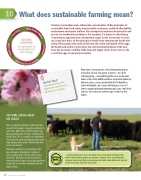
Many farmers choose practices such as planting native grasses, movingtheirlivestockfrompasturetopasture–wecallthis rotational grazing – and establishing buffer zones around water bodies to help sustain wildlife populations and promote biodiversity. And some species, such as grassland birds like the Bobolink or Eastern Meadowlark, rely on areas with tall grasses to nest. If farmers stopped planting and maintaining grass crops, small shrubs and trees start to take over and those types of birds lose their habitat.
1 0
The Real Dirt on Farming
Rob Voice, cattle and grain farmer, Bradwell, SK
... that Saskatchewan has over 40 per cent of Canada’s farmland? This helps Saskatchewan export cereal grains (wheat, oats, rye and barley), oilseeds (canola and flax), pulses (peas and lentils) and edible oils (canola) worth more than $4 billion every year.
Quick fact:
Saskatchewan has the highest per capita honey production in Canada.


