


Page 3 - #RealDirt - The Real Dirt on Farming: Saskatchewan Digest Edition
P. 3
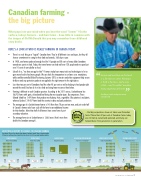
Canadian farming -
the big picture
What pops into your mind when you hear the word “farmer”? On the surface, today’s farmers – and their farms – have little in common with the images of Old McDonald that you may remember from childhood story books.
Here’S A LOOk AT WHO IS reALLY fArmInG In CAnAdA TOdAY:
• There’s no such thing as a “typical” Canadian farm. They’re all different sizes and types, but they all share a commitment to caring for their land and animals, 365 days a year.
• In 1900, one farmer produced enough food for 10 people and 50 cents of every dollar Canadians earned was spent on food. Today, that same farmer can feed well over 120 people and we spend just over 10 cents of every dollar on food.
• Like all of us, “we have an app for that”! Farmers today have many tools and technologies to let us grow more food to feed more people. We can check the temperature in our barns on a smartphone, while satellite-controlled Global Positioning Systems (GPS) on tractors and other equipment help ensure fertilizers and crop protection products are applied in the right amount to the right places.
• Less than two per cent of Canadians feed the other 98 per cent as well as helping to feed people right around the world. And we do it on less land and using fewer resources than before.
• Farming is different in each Canadian province. According to the 2011 census, Saskatchewan has 36,952 farms with grain, oilseed and beef being the most popular types. By comparison, Prince Edward Island has 1,495 farms that produce mostly dairy, fruits, vegetables (like potatoes) and plants, whereas Quebec’s 29,437 farms lead the country in dairy and pork production.
• The average age of a Saskatchewan farmer is 54. More than 70 per cent are men, and just under half of Canada’s farmers also have a job off the farm to earn additional income
“
Living and working on the land is a life like no other. Farming is both a business and a way
of life – and I couldn’t imagine doing anything different.
Carnduff, SK
for their families. More than half of all farmers have some form of post- secondary education.
• The average farm size in Saskatchewan is 1,668 acres (that’s more than double the Canadian average!).
... that big corporations have not taken over Canadian farms? More than 97 per cent of Canadian farms today are still family-owned and operated, and many are handed down from generation to generation.
Eric Buyer, cattle and grain farmer,
”
The Real Dirt on Farming 3
MORE THAN A CENTURY OF CHANGES TO CANADIAN FARMING
Over the past 110 years, there have been big changes in farming in Canada. Today, a decreasing number of farmers are working on fewer, larger farms to produce more food for a growing Canadian population.
FEWER FARMERS
Number of Farmers (Millions)
3.2 91% 0.3 1901 2011
FEWER FARMS
Number of Farms (1,000s)
511 60% 206 1901 2011
LARGER FARMS
Average Farm Size (Acres)
237 228% 778
HIGHER VALUED FARMLAND
MORE PEOPLE TO FEED
Canadaʼs Population (Millions)
5.4 548% 35
FEEDING MORE PEOPLE
People Fed By One Farmer
10 1,100% 120+ 1901 2011
Source: Statistics Canada, www.statcan.gc.ca
* Using current dollar values, not accounting for inflation
1941
2011
17 13,000% 2,227
1901
2014
$
1941
2013
Value of 1 Acre of Farmland ($)* $$$$$$$$$$$
$$$$$$$$$$$
$


