
By Clinton Monchuk, Executive Director, Farm & Food Care Saskatchewan
At the Ag Week Luncheon on October 6, Ashlyn George (The Lost Girls Guide to Finding the World) offered a reminder that applies to anyone who works in agriculture: people don’t connect with messages, they connect with stories.
I’ve noticed it myself: when you live and work in agriculture, terminology, practices and “what’s normal” become second nature. We forget how much background knowledge we have and consumers just don’t have that context. When it comes to interactions with consumers, we need to meet them where they are and use language they understand, avoiding jargon and buzzwords. Simple language makes our messages about agriculture more relatable and as Ashlyn put it, you don’t have to be corporate to be professional.
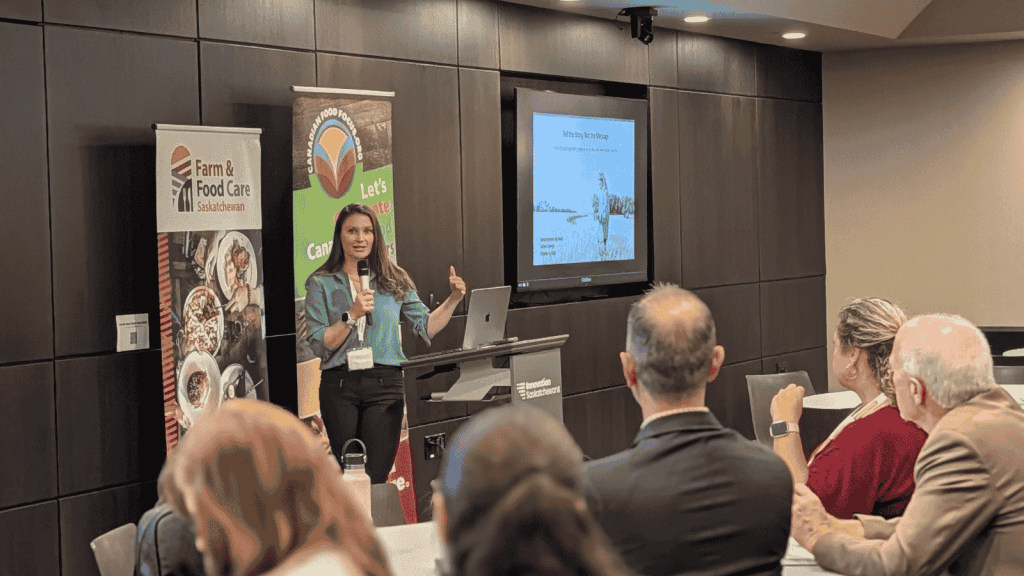
According to Ashlyn, good storytelling begins with two questions: ‘What does my audience need to understand?’ and ‘What will make them care enough to keep listening?’ Agriculture has plenty to work with. Science and technology in agriculture literally feeds the world and for the most part is interesting if people are presented with this information. Ashlyn’s formula is to educate, inspire and entertain, so people learn something, care about it and stay interested.
Capture people’s attention first, provide context, and save a surprise detail for the end. A hook can be a statement, a picture, a question, a fact or a video. Here’s one: a single piece of farm machinery can be worth more than a house. That fact makes people stop and ask why, which is the point. This then allows the conversation to go into what it takes to grow a crop and why this expensive piece of equipment is essential to growing food.
A good story gets one of these reactions:
- “I didn’t know that.”
- “Wait, what?”
- “Really?”
- “Wow.”
If your audience says any of those, you’ve created curiosity, and Ashlyn stressed that curiosity is the goal.
You also don’t have to hit on every single piece of agriculture at once. Instead, focus on one or two things and don’t shy away from those difficult questions. Tough topics are where trust is built or lost.
Our industry has a lot of stories worth telling. The challenge is to tell them in plain language, lead with what’s surprising and give people the context they need. Before your next post, presentation or conversation, ask yourself: would this make someone say “wait, what?”